Best AI Apps for Small Businesses: The Ultimate Guide to Growing Smarter in 2026
Artificial intelligence (AI) is no longer reserved for large corporations with massive budgets. Today, AI apps for small businesses are affordable, user-friendly, and designed to help entrepreneurs automate repetitive tasks, improve customer service, increase sales, and save valuable time.
Whether you own a retail store, marketing agency, restaurant, construction company, or online business, the right AI tools can help you compete more effectively while reducing operational costs.
This guide explores the best AI apps for small businesses and explains how each can improve productivity and profitability.
Why Small Businesses Should Use AI
AI technology helps businesses:
- Automate repetitive work
- Generate marketing content
- Improve customer support
- Analyze customer behavior
- Create social media posts
- Manage finances
- Increase productivity
- Save time and money
- Improve decision-making
- Generate leads faster
Businesses that embrace AI often spend less time on administrative work and more time serving customers and growing revenue.
1. ChatGPT
One of the most popular AI assistants available today, ChatGPT helps businesses create high-quality content in minutes.
Best Uses
- Blog writing
- Email marketing
- Product descriptions
- Website copy
- Customer support responses
- Business plans
- Social media captions
- FAQ creation
Perfect for entrepreneurs who want professional-quality writing without hiring multiple writers.
2. Canva AI
Canva’s AI features make graphic design easy—even for beginners.
Features
- AI image generation
- Social media graphics
- Flyers
- Logos
- Business presentations
- Marketing materials
- Video editing
Small businesses can produce professional-looking visuals quickly and affordably.
3.Grammarly
Grammarly uses AI to improve written communication.
It helps with:
- Emails
- Business proposals
- Blog posts
- Marketing copy
- Reports
- Grammar corrections
- Tone adjustments
Professional communication builds customer trust.
4. QuickBooks AI
Accounting becomes easier with AI-powered bookkeeping.
Benefits include:
- Expense tracking
- Invoice management
- Cash-flow monitoring
- Financial reports
- Tax preparation assistance
Small business owners spend less time managing finances.
5. HubSpot AI
HubSpot combines customer relationship management (CRM) with AI-powered marketing tools.

Features include:
- Email automation
- Lead scoring
- Sales forecasting
- Customer insights
- Marketing automation
- Content suggestions
Ideal for businesses looking to grow sales efficiently.
6. Jasper AI
Jasper specializes in marketing content creation.
Businesses use it for:
- SEO articles
- Facebook ads
- Google Ads
- Product descriptions
- Email campaigns
- Sales pages
- Landing pages
It’s especially useful for companies publishing content regularly.
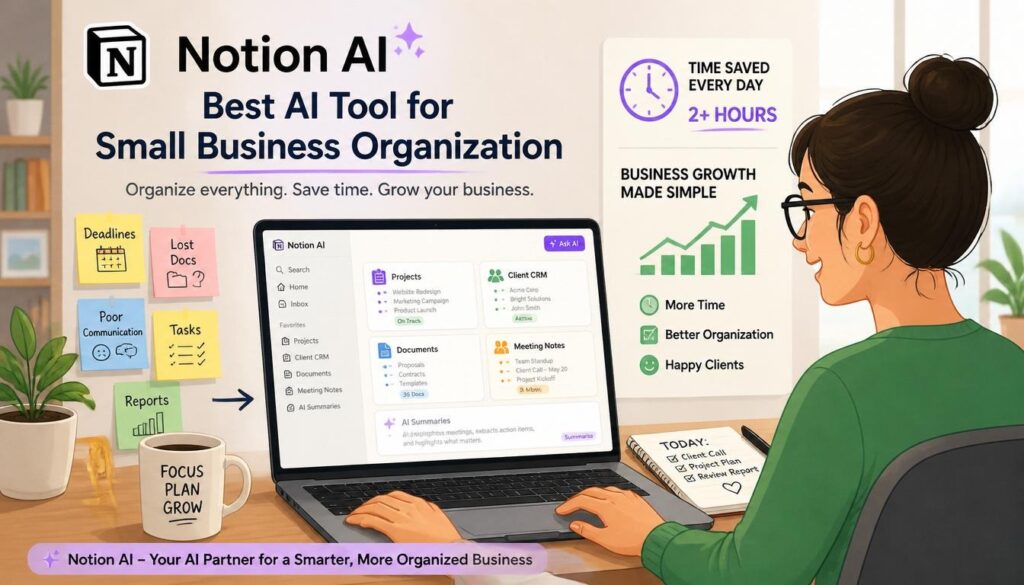
7. Notion AI
Notion AI improves workplace organization.
Use it to:
- Summarize meetings
- Create project plans
- Generate documents
- Organize business knowledge
- Brainstorm ideas
Excellent for teams managing multiple projects.
8. Fireflies.ai
Fireflies records and summarizes meetings automatically.
Features include:
- Meeting transcription
- Action items
- Searchable notes
- Team collaboration
- Integration with Zoom and Google Meet
Business owners no longer need to take detailed meeting notes manually.
9. Zapier AI
Automation saves businesses countless hours.
Zapier connects hundreds of apps to automate workflows.
Examples include:
- Automatically sending leads to your CRM
- Posting social media updates
- Email automation
- Customer notifications
- Data synchronization
Automation reduces repetitive manual work.
10. Copy.ai
Copy.ai helps businesses generate marketing content quickly.
Popular uses:
- Sales emails
- Product descriptions
- Blog ideas
- Website copy
- Cold outreach
- Ad copy
A valuable tool for startups with limited marketing budgets.
Benefits of AI for Small Businesses
Using AI can help businesses:
- Reduce operating costs
- Increase efficiency
- Improve customer satisfaction
- Respond faster to inquiries
- Generate more leads
- Publish content consistently
- Enhance marketing performance
- Make data-driven decisions
- Increase employee productivity
- Scale operations with fewer resources
Choosing the Right AI App
When selecting an AI solution, consider:
- Your business goals
- Ease of use
- Integration with existing software
- Monthly pricing
- Security and privacy
- Customer support
- Scalability
- Available features
Many AI platforms offer free trials, allowing you to evaluate them before committing.
The Future of AI in Small Business
AI adoption is accelerating across industries. As tools become more accessible, small businesses can leverage advanced capabilities that were once available only to large enterprises. From personalized customer experiences to predictive analytics and intelligent automation, AI will continue to transform how businesses operate and compete.
Businesses that adopt AI thoughtfully—while maintaining a human touch—will be well-positioned for long-term growth.
Frequently Asked Questions
What is the best AI app for small businesses?
The best choice depends on your needs. ChatGPT is excellent for writing and brainstorming, Canva AI for design, QuickBooks AI for accounting, and HubSpot AI for marketing and customer relationship management.
Are AI apps expensive?
Many AI tools offer free plans or affordable monthly subscriptions, making them accessible for startups and small businesses.
Can AI replace employees?
AI is best used to automate repetitive tasks and support employees, allowing teams to focus on strategic, creative, and customer-facing work.
Is AI safe for business use?
Reputable AI platforms provide security features, but businesses should still review privacy policies, protect sensitive information, and verify AI-generated content before publishing.